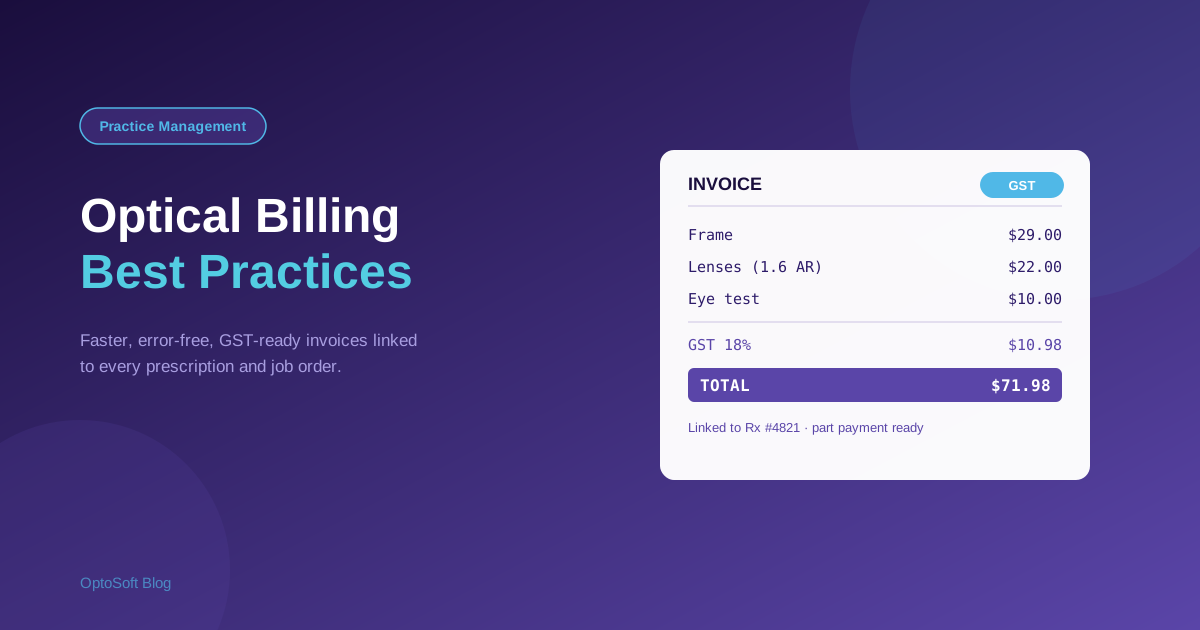
Billing is where an optical shop gets paid, so it has to be fast and accurate. But optical billing is not like a normal retail receipt: a single sale links a prescription to frames, lenses and add-ons, often with advances and part payments, and in India it must be GST-compliant. This guide covers the best practices that keep optical billing quick, correct and audit-ready.
Why optical billing is different
A spectacle sale is really a small custom order. One invoice can combine a frame, a specific lens (with index, coating and tint), a fitting charge and an eye-test fee — all tied to a particular prescription and job order. Payments are often split into an advance at order time and the balance on collection. Generic billing apps do not model this well; optical billing needs to.
What a compliant optical invoice must include
For shops in India, a GST-compliant invoice should carry your GSTIN, the customer details, HSN/SAC codes for goods and services, the taxable value, the CGST/SGST (or IGST) breakup, and the invoice number and date. Spectacles and lenses are goods; eye tests and fitting are services — so a single optical bill often mixes both, which your billing must handle on one document.
Best practices for accurate, fast billing
Link the bill to the prescription and job order
Every invoice should reference the prescription and the job/order number. This prevents wrong-lens errors, makes reorders trivial, and gives a clean audit trail from sale back to clinical record.
Standardise lens add-on pricing
Define fixed prices for coatings, indices and tints so staff are not guessing. Consistent add-on pricing speeds up billing and stops revenue leaking through under-charged extras.
Handle advances and part payments cleanly
Record the advance against the order and show the outstanding balance on the invoice. For example, a ₹6,000 spectacle order with a ₹2,000 advance should clearly show ₹4,000 due on collection — visible to both staff and customer.
Automate GST and tax reports
Let the software calculate GST per line and generate period tax reports. Manual tax math on each bill is slow and error-prone; automation keeps filing painless and accurate.
Reducing billing errors and disputes
Most billing disputes come from unclear balances, wrong add-on charges, or a bill that does not match the order. Itemised invoices linked to the prescription, a visible advance/balance, and standard pricing remove almost all of these. Keep a digital copy of every invoice so any query can be resolved in seconds.
Manual bills vs. optical billing software
Handwritten or generic bills cannot link to prescriptions, calculate GST reliably, or track part payments across visits. Purpose-built optical billing does all three automatically, and ties each bill to the patient record so the next visit starts with full history.
How OptoSoft handles GST-ready optical billing
OptoSoft generates GST-compliant invoices in ₹ with HSN codes, the correct CGST/SGST breakup, and goods-plus-services on one document. Bills link to the prescription and job order, advances and balances are tracked automatically, and tax reports are one click away. See OptoSoft for India for GST billing, or the wider features and optical POS module.
Frequently asked questions
What should an optical shop invoice include in India?
A GST-compliant optical invoice should include your GSTIN, customer details, HSN/SAC codes, taxable value, the CGST/SGST or IGST breakup, and a unique invoice number and date. Because a spectacle sale mixes goods (frames, lenses) and services (eye test, fitting), the bill should itemise both.
Is GST billing mandatory for opticians?
Opticians in India whose turnover crosses the GST registration threshold must register and issue GST-compliant invoices. Thresholds and rules change, so confirm current requirements with a tax professional or the GST portal.
Can optical billing software link bills to prescriptions?
Yes. Purpose-built optical billing software links each invoice to the patient prescription and job order, which prevents wrong-lens errors, simplifies reorders and creates a clean audit trail.
How do I bill part payments for spectacles?
Record the advance against the order and show the outstanding balance on the invoice, so a part-paid spectacle order clearly displays how much was paid and how much is due on collection. Good software tracks this automatically across visits.
Want GST-ready optical billing? See OptoSoft for India or view pricing and the free plan.