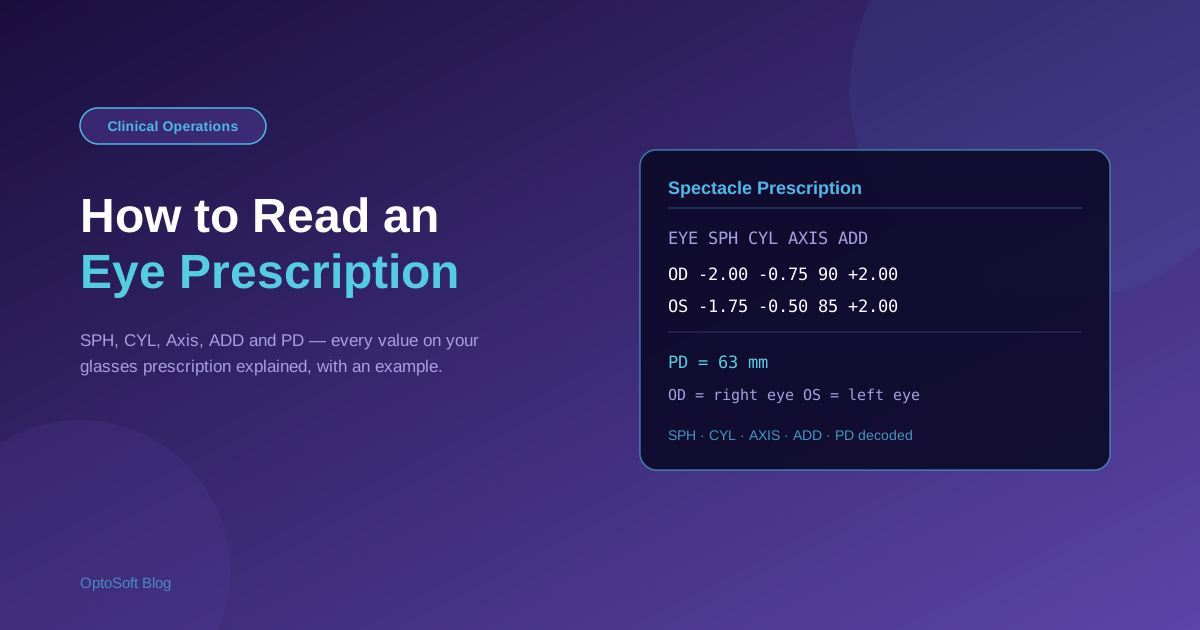
Your glasses prescription is a short table of numbers and abbreviations — SPH, CYL, AXIS, ADD, PD — that tells an optician exactly how to make your lenses. Once you know what each value means, the whole prescription becomes easy to read. This guide explains every field in plain English, with a worked example at the end.
What a glasses prescription looks like
A typical spectacle prescription is laid out as a small table, one row per eye:
| Eye | SPH (Sphere) | CYL (Cylinder) | AXIS | ADD |
|---|---|---|---|---|
| OD (right) | -2.00 | -0.75 | 90 | +2.00 |
| OS (left) | -1.75 | -0.50 | 85 | +2.00 |
Most values are written in steps of 0.25 dioptres (D), the unit that measures lens power. A plus (+) sign means the lens converges light; a minus (−) sign means it diverges light.
SPH (Sphere): the main lens power
SPH is the primary correction, measured in dioptres. A minus value (e.g. −2.00) corrects myopia (short-sightedness); a plus value (e.g. +1.50) corrects hyperopia (long-sightedness). The further the number is from zero, the stronger the correction — so −4.00 is a stronger myopic lens than −1.00. A value near 0.00 (sometimes written Plano or PL) means little or no spherical correction is needed.
CYL (Cylinder): astigmatism correction
CYL is the amount of correction for astigmatism — an eye that is shaped more like a rugby ball than a sphere. If the CYL column is blank, you have no significant astigmatism. When present, CYL is paired with an AXIS value, because cylindrical power only acts along one specific direction.
AXIS: the direction of the cylinder
AXIS is a number from 1 to 180 that describes the orientation, in degrees, where the cylinder power sits. It is not a strength — it is an angle. AXIS only appears when there is a CYL value, and it tells the lab how to rotate the astigmatism correction so it lines up with your eye.
ADD: the reading addition
ADD is extra plus power added to the bottom of the lens to help with close-up vision, used in bifocal and progressive (varifocal) lenses. It is always a plus value (e.g. +2.00) and is usually the same for both eyes. ADD typically appears once people reach their 40s and develop presbyopia, the age-related loss of near focus.
PD (Pupillary Distance): centring the lenses
PD is the distance in millimetres between the centres of your two pupils. It is not part of your refractive correction, but the lab needs it to position the optical centre of each lens directly in front of each pupil. A typical adult PD is roughly 54–74 mm. It may be written as a single number (e.g. 63) or as two monocular figures (e.g. 31.5 / 31.5).
PRISM and BASE (when present)
Some prescriptions include a PRISM value (in prism dioptres) and a BASE direction (up, down, in, or out). Prism is used to correct eye-alignment problems such as double vision. Most everyday prescriptions leave these fields blank.
OD, OS and OU explained
These are Latin abbreviations still used on most prescriptions:
- OD (oculus dexter) = right eye
- OS (oculus sinister) = left eye
- OU (oculus uterque) = both eyes
Worked example: reading a full prescription
Using the table above, the right eye (OD) reads: −2.00 SPH (moderate short-sightedness), −0.75 CYL at AXIS 90 (a small amount of astigmatism oriented vertically), and +2.00 ADD (reading boost for a progressive lens). The left eye (OS) is slightly less short-sighted at −1.75 with −0.50 of astigmatism at axis 85. The PD of 63 mm tells the lab where to centre both lenses. Put together, this is a progressive prescription for someone who is mildly short-sighted with light astigmatism and needs reading support.
Keeping prescriptions accurate and reusable
For an optical store, the prescription is the single most important record attached to every order. Re-keying SPH, CYL, axis and ADD by hand on each visit is where errors and remakes creep in. Storing each prescription digitally — linked to the patient and to every spectacle and contact-lens order — means staff can reorder, compare against the previous Rx, and dispense without transcription mistakes. That is exactly what OptoSoft digital eye prescription software is built to do, and it connects to contact lens fitting records on the same patient file. If you also run exams and clinical workflows, see OptoSoft optometry practice management. For a deeper look at storing patient Rx data, read our guide to patient prescription management software.
Frequently asked questions
What does SPH mean on an eye prescription?
SPH (sphere) is the main lens power in dioptres. A minus value corrects short-sightedness (myopia) and a plus value corrects long-sightedness (hyperopia). The further from zero, the stronger the lens.
What is a normal PD for glasses?
Pupillary distance for most adults falls between about 54 and 74 mm, with a common average near 62–64 mm. Children's PD is smaller. It is measured in millimetres between the centres of the pupils.
What does ADD mean on a prescription?
ADD is the extra plus power added for reading or close work, used in bifocal and progressive lenses. It is always a plus number and is usually the same for both eyes.
Is a higher SPH number worse?
A number further from zero means a stronger correction is needed, so −5.00 is a stronger prescription than −1.00. It reflects the amount of correction, not the health of your eyes.
What is the difference between OD and OS?
OD (oculus dexter) means the right eye and OS (oculus sinister) means the left eye. OU means both eyes together.
Run an optical store? Store every prescription digitally and dispense without re-keying — see OptoSoft digital prescription software or view pricing and the free plan.