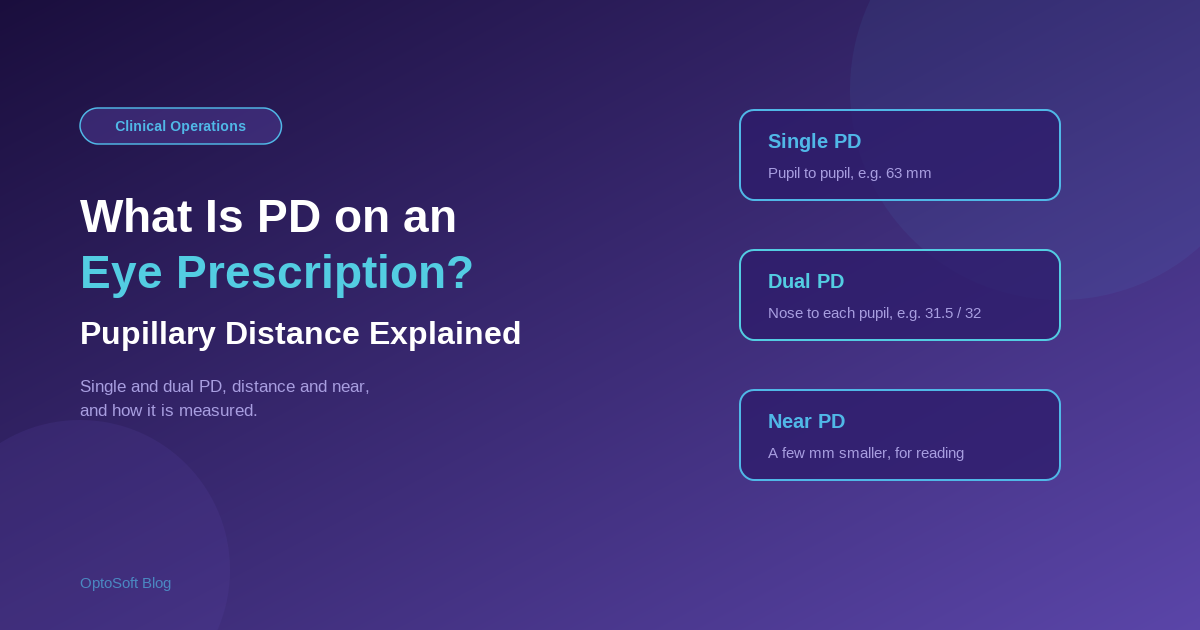
PD stands for pupillary distance: the distance between the centres of your two pupils, measured in millimetres. On a glasses prescription or order it tells the lab where to place the optical centre of each lens, so that it sits directly in front of each eye. PD is not a lens power. It is a measurement of your face.
What PD means on a prescription
Every lens has an optical centre, the point where it gives the clearest vision. For glasses to work as prescribed, that point has to line up with the pupil. The PD gives the lab the distance it needs to do that. It is written in millimetres, for example PD 63.
PD is separate from the values that describe the correction itself. For those, see our guide to how to read an eye prescription.
Single PD and dual PD
- Single PD (also called binocular PD) is one number: the distance from one pupil to the other, for example 63.
- Dual PD (also called monocular PD) is two numbers: the distance from the centre of the nose to each pupil, for example 31.5 / 32. The right eye is normally written first.
Faces are rarely perfectly symmetrical, so the two halves are often slightly different. Dual PD records that difference and is the more precise of the two. It matters most for progressive lenses and for stronger prescriptions.
Distance PD and near PD
When you look at something close, your eyes turn slightly inwards, so the distance between the pupils becomes a little smaller. That is why there are two versions:
- Distance PD is used for glasses worn for far vision and general wear.
- Near PD is used for reading glasses. It is usually a few millimetres smaller than the distance PD.
What is a normal PD?
For adults, PD typically falls between about 54 and 74 mm. Children have smaller PDs, which increase as they grow. There is no good or bad value. The only thing that matters is that the figure used to make your glasses is your own.
How PD is measured
An optician or optometrist measures PD with a pupillometer or a millimetre ruler held against the brow while you look at a fixed point. It takes a few seconds. For progressive lenses the optician also measures the fitting height, which is how high the pupil sits in the chosen frame.
You can measure PD yourself with a ruler and a mirror, and the result is usually close enough for simple low-power glasses. For progressive lenses or strong prescriptions, have it measured by an optician.
Why PD is sometimes missing from a prescription
PD is often not written on the prescription you are given after an eye test. The prescription records the correction your eyes need. The PD is commonly measured later, by the person who fits and orders the glasses, as part of the fitting measurements. Whether it must be given to you on request depends on the rules where you live. If you need it, ask the optician who measured it.
What happens if the PD is wrong?
If the lenses are made with the wrong PD, their optical centres do not line up with your pupils. In low prescriptions a small error may not be noticed. As the power increases, the same error can cause eye strain, headaches, or blurred and uncomfortable vision. If new glasses feel wrong and the prescription is correct, the PD is one of the first things an optician will check.
For optical shops: record PD with the prescription
PD does not change much in adults, but it should be stored with every prescription and order so that a repeat pair can be made without measuring again and a remake can be traced. OptoSoft stores PD together with SPH, CYL, AXIS and ADD in the customer prescription record, and prescription records are part of the free plan. See digital eye prescription software.
Frequently asked questions
What is PD in an eye prescription?
PD means pupillary distance: the distance between the centres of your two pupils, in millimetres. The lab uses it to place the optical centre of each lens directly in front of each eye. It is a measurement of your face, not a lens power.
What is the difference between single PD and dual PD?
Single PD is one number, the distance from pupil to pupil, such as 63. Dual PD is two numbers, the distance from the centre of the nose to each pupil, such as 31.5 / 32. Dual PD is more precise and matters most for progressive lenses and strong prescriptions.
What is a normal PD?
For adults, PD typically falls between about 54 and 74 mm. Children have smaller values. There is no good or bad PD; what matters is that your own measurement is used to make your glasses.
Why is PD not on my prescription?
The prescription records the correction your eyes need. PD is often measured later by the person who fits and orders the glasses, so it may not be written on the prescription. If you need it, ask the optician who measured it.
Can I measure my own PD?
Yes, with a millimetre ruler and a mirror, and the result is usually close enough for simple low-power glasses. For progressive lenses or strong prescriptions, have an optician measure it.
Run an optical shop? Keep every prescription and PD on record with OptoSoft or start on the free plan.