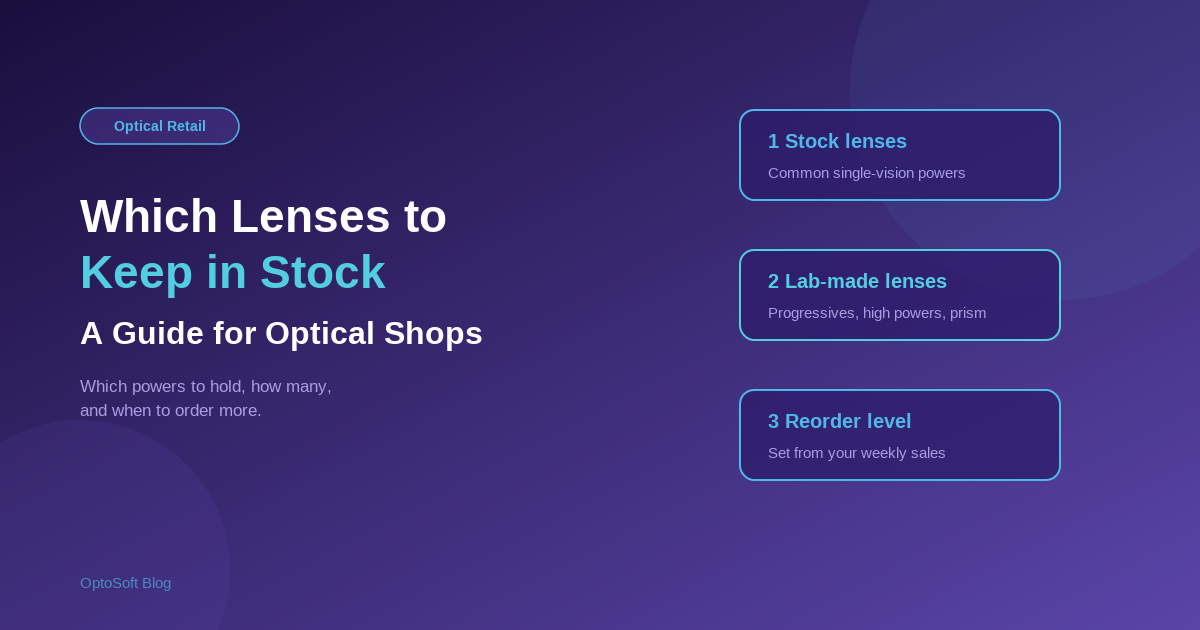
Yes. Most optical stores keep the most common single-vision lens powers in stock, so that a simple pair of glasses can be made the same day or the next day. Everything else, such as progressives, high powers and lenses with special coatings, is ordered from the lens lab for that customer. The useful question for a shop owner is not whether to hold stock lenses, but which powers, how many, and when to reorder. This guide covers each of those.
Do optical stores keep common lens powers in stock?
Usually, yes. A shop that edges and fits lenses itself, or works with a nearby fitting lab, normally keeps a drawer of finished single-vision lenses in the powers it sells most. That stock is what makes a fast turnaround possible. A shop that sends every job to an outside lab may keep little or no lens stock, because the lab holds it instead. Both models work. What matters is that the stock you hold matches what your customers actually need.
Stock lenses and lab-made lenses: the difference
A stock lens (also called a finished lens) is made in bulk by the manufacturer in a fixed power, already surfaced and usually already coated. The shop only has to cut it to the frame shape. A lab-made lens (also called a surfaced or Rx lens) is produced for one prescription from a semi-finished blank. Stock lenses are cheaper and quicker. Lab-made lenses cover the prescriptions that stock ranges do not.
Which lens powers are usually kept in stock
Each supplier publishes the range in which a lens is available from stock, so check the list for every lens you sell. As a general pattern, shops hold:
- Low and moderate single-vision powers, both minus and plus, in 0.25 steps.
- The same powers with a low cylinder, because a large share of prescriptions include a small amount of astigmatism.
- One or two materials or indexes that most customers choose, with the coating most customers choose.
- Ready reading powers, if the shop sells simple reading glasses.
Hold lenses in pairs of the powers that sell, not one of everything. A wide range with one lens per power looks complete and still fails the customer who needs two.
What almost always goes to the lab
- Progressive and bifocal lenses.
- High sphere powers and high cylinders outside the supplier stock range.
- Prescriptions with prism.
- Special tints, photochromic or polarised options the shop sells only occasionally.
- Large or unusual frame shapes that need a bigger lens diameter.
For these jobs the speed comes from a clean lab order, not from stock. See how to manage optical lab orders.
How to decide what your shop should hold
- Start from your own sales. List the lens powers you sold in the last 6 to 12 months and count each one. The top of that list is your stock range.
- Stock the fast movers first. A small set of powers usually accounts for most single-vision jobs. Add slower powers only when the money and drawer space allow.
- Compare with the lab lead time. If your lab delivers in a day, you need less stock. If it takes a week, stock earns its place.
- Count the cash. Lens stock is money sitting in a drawer. A power that has not sold in six months is dead stock, the same as a frame that has not sold.
Setting reorder levels and counting the drawer
Give every stocked power a reorder level: the quantity at which you order more. Set it from how many you sell in the time the supplier takes to deliver, plus a small margin. A power you sell four times a week with a one-week delivery needs a higher level than one you sell twice a month.
Then count. Lenses are small, look alike, and are easy to put back in the wrong envelope. A short count of one section of the drawer each week finds errors before a customer does. The full method is in our guide to optical shop inventory management.
Common mistakes
- Buying the supplier starter range unchanged. It reflects an average shop, not yours.
- Stocking too many materials and coatings. Each option multiplies the number of lenses you must hold.
- No record of what was used. If a lens leaves the drawer without being recorded against a job, the reorder never happens.
- Ignoring scratched or mislabelled lenses. Write them off, or the count says you have stock you cannot sell.
How OptoSoft helps
On its paid plans, OptoSoft keeps frame and lens stock in one place, lets you set a reorder level for each item with low-stock alerts, raises supplier purchase orders, and supports stock counts that correct the quantities. Jobs that cannot be filled from stock go to the lab as a lab order from the same sale. See optical inventory management in OptoSoft.
Frequently asked questions
Do optical stores keep common lens powers in stock?
Yes, most do. Optical stores that fit lenses themselves usually keep finished single-vision lenses in the powers they sell most, so simple glasses can be made the same or the next day. Progressives, high powers and special options are ordered from the lens lab for each customer.
What is a stock lens?
A stock lens, also called a finished lens, is made in bulk by the manufacturer in a fixed power, already surfaced and usually coated. The optical shop only cuts it to the frame shape. It costs less and is quicker than a lens made by the lab for one prescription.
Which lenses are not kept in stock?
Progressive and bifocal lenses, high sphere or cylinder powers outside the supplier stock range, prescriptions with prism, and rarely sold tints or coatings are normally made by the lab to order.
How many stock lenses should a small optical shop hold?
There is no fixed number. Count the lens powers you sold in the last 6 to 12 months, stock the powers that sell most often in pairs, and set a reorder level for each from your weekly sales and the supplier delivery time.
Want lens stock that matches what you sell? See inventory in OptoSoft or compare the plans.